Local Law 126_CGI Northeast

New York City Department of Buildings (NYCDOB) LL126, Article 323, requires building owners to complete a series of steps to help improve the safety of parking garage structures in all five boroughs. A parking structure is defined as a building or space used for parking or storage of motor vehicles, other than an automotive service station, automotive repair shop, or private garages serving one- and two-family homes not exceeding 650 square feet in area and one-story height.
The Periodic Inspection of Parking Structure (PIPS) requires the parking structure owner to be responsible for its proper inspection, repair and maintenance. The owner shall retain a New York State licensed professional engineer (PE) to examine the parking structure every six years and file a PIPS report. The PE must be certified as a Qualified Parking Structure Inspector (QPSI).
One of the main causes of structural integrity issues (i.e. corroding of steel reinforcement, concrete spalling, concrete degradation, etc.) is groundwater intrusion. The DOB is enforcing violations for the presence of groundwater in the Parking Garages. To perform the specified concrete repairs (i.e. reinforcement steel repair, concrete patching, forming and pouring, etc.), the groundwater must be remediated prior to attempting these repairs.
CGI Northeast Inc. has the means and methods to rectify these groundwater intrusion issues safely and effectively in accordance with the Local Law 126 mandates. The negative side injection waterproofing to remediate the groundwater intrusive locations is primarily performed with utilizing acrylate resins. CGI NE offers other services. Once the water intrusion is rectified, our Team can perform the concrete patching and rebar repairs. We perform cementitious grout injections and epoxy crack injections to stabilize concrete walls with structural integrity issues. Our mechanics also perform foam injections to stabilize soil and fill-in voids within the soil. In addition, the field personnel perform coating applications, breathable for foundation walls and epoxy coatings on floor slabs.

The Concrete Gel Injection waterproofing system is cost effective and is a convenient solution to remedy below grade water intrusion issues. Concrete Gel Injection is performed by drilling and injecting through the negative (interior side), a two-component hydrophilic resin system, that chemically reacts to form a flexible water sealing gel. The gel is non-toxic, odor free, and environmentally friendly. The gel will remain within the concrete or masonry structural for the life of the structure. By implementing its technology from the interior side, costly and disruptive exterior excavations are eliminated. Also, it is impossible to excavate in the city at 15-25 ft. below street-sidewalk grade to reach leaking cellar or groundwater table sub-cellar locations.
The acrylate resin and the additives are close to the same viscosity as water, these fluids can migrate into the tiniest of cracks, fissures and water pockets within the depth of the concrete, brick or rubble. The 2 components can be calibrated to form a gel as fast as 5 seconds. A fast-setting time is crucial when injections are taking place at levels within the groundwater table, where hydrostatic pressure can be excessive. The two-stage hydraulic pumps that have a discharge pressure of up to 3,200 psi can push out the groundwater under this great hydrostatic pressure. This factor along with a fast -setting time of the resulting gel are unique features when implementing the CGI waterproofing system. The resulting CGI gel can coexist with oily water, brackish water and sewage water.
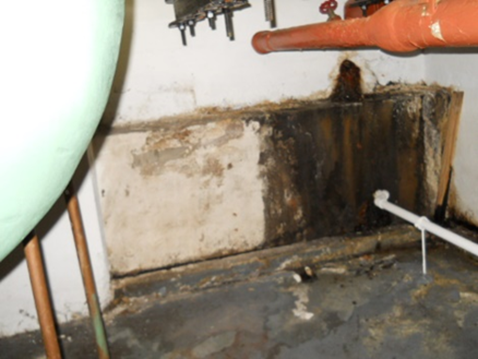
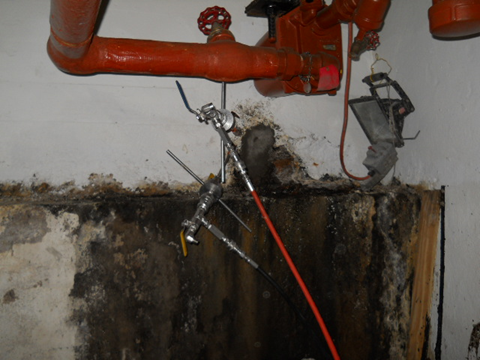
With the CGI system, the holes are bored within the depth of the concrete or masonry structure toward the exterior soil side, but never all the way to the soil exterior side. With traditional curtain wall grout injection holes are drilled all the way through the depth of the concrete or masonry structure to the soil exterior side in a grid pattern. Usually, the holes are spaced every 18 to 24 inches from top to bottom and left to right. Ports are inserted in these bored holes and then the grout is pumped into the exterior side to form a foam or urethane layer between the exterior of the foundation wall and the soil. This is a more time-consuming procedure. The ports are made of hydrocarbon steel and are difficult to remove. Often, many grout injection mechanics leave them in the wall, as they are tedious to remove. When the holes are filled with the urethane full depth, the foam backs up and rolls down the interior side of the wall, and it looks messy. Even if the grout injection curtain wall ceases the water intrusion initially, the exterior soil side urethane wall will break down in the presence of water. The steel ports will eventually corrode and bring water back to the interior side. The CGI waterproofing system does not require ports. When the holes are bored, the mechanics twist in tools with nozzles that have a rubber gasket to seal tightly within the bored holes. Once the injections are completed. The manual tools with the rubber gaskets on the nozzles are removed and the bored holes are closed with hydraulic cement.

With newer construction where exterior conventional waterproofing membrane has been applied to the exterior side of a foundation wall, the waterproofing membrane may have been compromised from poor workmanship or backfilling (causing the puncturing of the applied membrane). The CGI system should be utilized by drilling within the substrate but never to the exterior side. The two components will then migrate to the exterior side to form a gel that will seal where the membrane has been compromised. The resin liquid components will follow the path of where the water emerges from and then result in the gel, sealing the water entry point(s). Curtain wall injections will only pierce and compromise more membrane, as holes will need to be drilled full depth to the exterior soil side. Architects and Engineers like the fact that no further membrane needs to be compromised or pierced when utilizing the CGI waterproofing system.
In New York City Properties, quite often there is no access to the exterior side of a building (within a property line). Therefore, there is either little or no access to the exterior side of a property line foundation wall. Depending on the neighbor’s cooperation and permission to access the exterior side of a property line wall, only a portion of the wall can be conventionally waterproofed. This is blind side waterproofing and in almost all instances the groundwater intrusion will become evident through this property line foundation wall.
This is the beauty of the CGI waterproofing system, when access to the exterior side of a foundation wall is not granted. With older buildings that were constructed adjacent to another building, there is no other option but to implement negative side injection waterproofing from the interior side.

One of the most cost-effective solutions that CGI offers by not needing to drill/inject to the exterior side is under vaulted horizontal structural slabs of plazas, exterior parking lots (above the interior side of parking garages), and sidewalk vaulted slabs. By drilling/injecting within the underside of these structural slabs, the resin liquid components will seal the water entry points.
This can be an enormous cost savings for the client, especially with plazas that have pavers. With conventional means, the pavers and overburden would need to removed down to the top exterior side of the waterproofing membrane. The membrane would need to be removed, and new waterproofing membrane re-applied to overlap the remaining existing membrane. Then overburden re-applied and the pavers replaced.
Management companies and ownership companies need to stay ahead of the game, as the DOB is taking structural integrity issues and groundwater intrusion very seriously. CGI Northeast is ready to serve these clients before, during and after a certified PE’s inspection report. We have been in business for 22 years and will meet the challenge of Local 126 mandates in the future.


Comments